
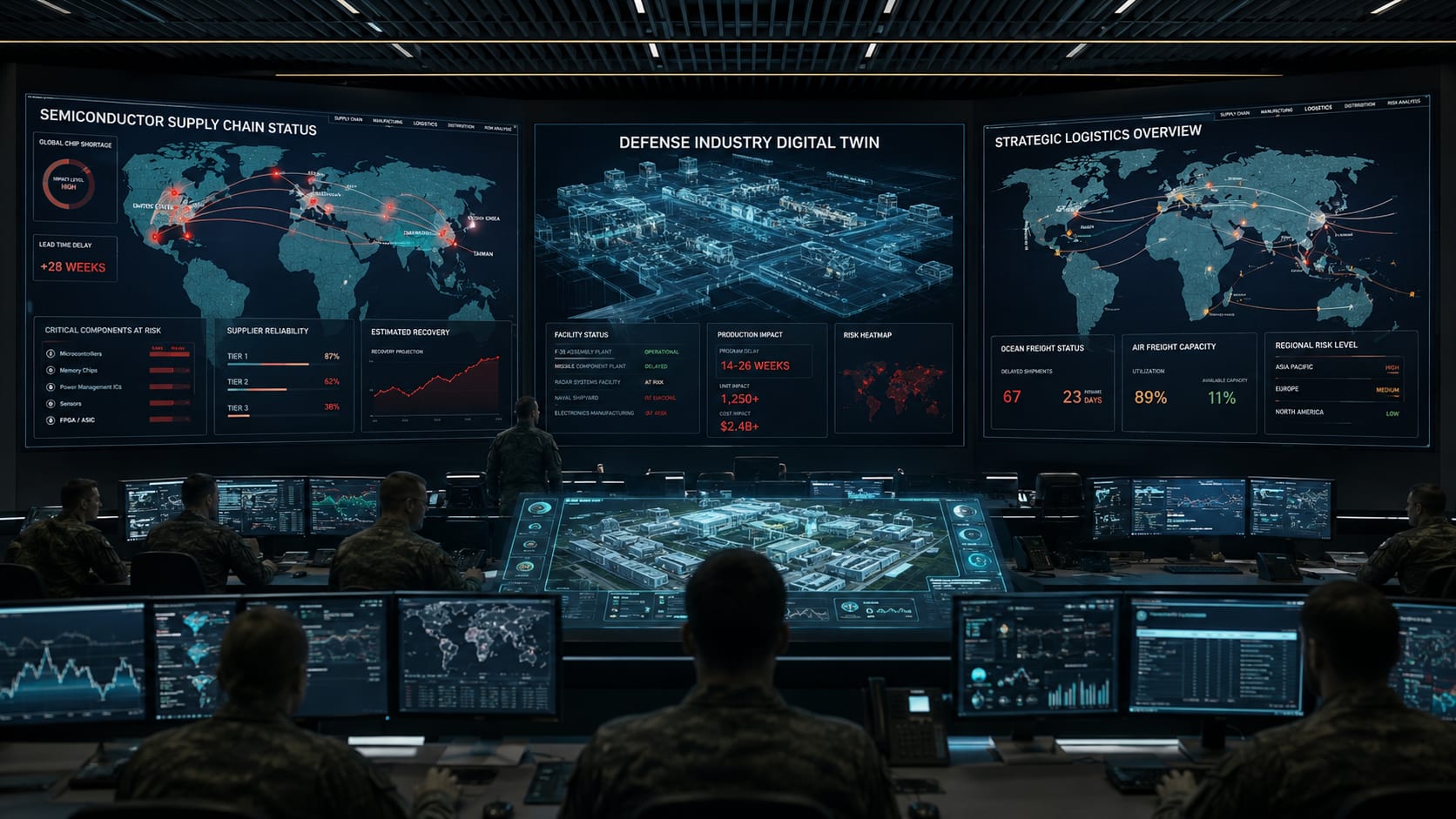
The microchip crisis—one of the most critical supply chain issues the global economy has faced in recent years—has affected many sectors, from the automotive industry to consumer electronics. However, there is another sector whose impact is often overlooked: the defence industry.
Modern defence systems rely on thousands of different semiconductor components, ranging from radar technologies to unmanned aerial vehicles, and from communication systems to command and control infrastructure. Consequently, global disruptions in microchip production have significant implications not only economically but also in terms of strategic and national security.
In this context, digital twin technologies are emerging as a critical tool for enhancing the resilience of the defence industry’s supply chain, anticipating risks and strengthening decision-making processes.
What is the Microchip Crisis?
The microchip crisis refers to supply bottlenecks arising from semiconductor production capacity being unable to meet global demand. The COVID-19 pandemic, geopolitical tensions, disruptions at production facilities and rising technological demand are among the key causes of this crisis.
In particular, high-performance processors, sensors and communication chips used in advanced defence systems are dependent on a limited number of manufacturers, thereby further increasing the risk of supply shortages.
Dependence on Microchips in the Defence Industry
Today’s defence platforms are no longer composed solely of mechanical systems. A modern defence ecosystem comprises
unmanned aerial vehicles,
radar and electronic warfare systems,
missile guidance systems,
satellite communications infrastructure,
command and control centres,
cybersecurity infrastructure
and other high-tech components.
All of these systems rely on the coordinated operation of thousands of semiconductor components with varying specifications. Even a delay in the supply of a single critical microchip can extend the delivery times of projects worth millions of dollars by several months.
The Impact of the Microchip Crisis on the Defence Industry
Microchip supply issues in the defence sector are leading to a number of critical consequences:
Delays in Production Processes
Defence projects typically have long production cycles. A shortage of critical components can bring the entire production line to a standstill.
Cost Increases
Semiconductor costs are rising due to reduced supply, which directly affects the overall budgets of defence projects.
Increased Operational Risks
Delays in spare parts and maintenance processes can threaten the operational continuity of active systems.
Strategic Dependency Issues
The concentration of semiconductor production capacity in certain countries is increasing geopolitical risks for defence industries.
How Do Digital Twin Technologies Offer a Solution to the Microchip Crisis?
Digital twin technology enables the creation of virtual replicas of physical systems, fed with real-time data. In the defence industry, this approach makes it possible to model not only production processes but the entire supply chain ecosystem.
1. Supply Chain Simulations
Thanks to digital twin platforms, defence organisations can:
analyse critical component dependencies,
test alternative supply scenarios,
simulate potential bottlenecks in advance,
assess risk levels in real time.
This enables action plans to be drawn up before a crisis occurs.
2. Scenario Analysis and Decision Support Systems
Potential disruptions in microchip production can be modelled in a digital environment. Decision-makers can:
Anticipate the operational impacts of various scenarios such as:
Supplier loss,
Production delays,
Logistics disruptions,
Geopolitical risks
in advance.
This approach strengthens data-driven decision-making processes in defence projects.
3. Real-Time Monitoring and Early Warning Mechanisms
Digital twin platforms, fed by IoT sensors, ERP systems and operational data sources, can detect anomalies in the supply chain in real time.
This enables early warning mechanisms to be activated before critical component shortages arise.
4. Production and Resource Optimisation
By creating digital twins of defence production facilities,
production capacity,
resource utilisation,
workforce planning,
and critical stock levels
can be continuously optimised.
This approach can significantly mitigate the impact of microchip shortages on production.
The Future of Resilient Supply Chains in the Defence Industry
Competitive advantage in the defence sector is no longer limited to producing advanced platforms. These platforms must also be supported by sustainable, resilient and predictable supply chains.
Digital twin-based decision support systems provide defence organisations with:
Real-time visibility,
Risk simulation,
Scenario analysis,
Operational optimisation,
Strategic planning
capabilities.
As microchip crises, geopolitical risks and global supply chain issues persist in the coming period, digital twin technologies will continue to be one of the key technologies enhancing the strategic resilience of the defence industry.
Conclusion
The microchip crisis has clearly demonstrated just how dependent the defence industry is on global supply chains. In this new era, organisations must not only respond to current challenges but also anticipate future risks.
Digital twin technologies contribute to the creation of more resilient, flexible and predictable operations within the defence industry through real-time monitoring, scenario simulation and data-driven decision support systems.