
01
The full line in first person
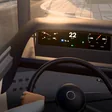
Through the headset the driver works a complete bus cab: the roundabout, a speed bump, signals and docking at the stop, then the doors open for boarding passengers — every step logged.
Moza direct-drive steering, a 2-DOF motion seat and a virtual cockpit worked with VR hands — a risk-free platform where every move becomes telemetry for the driving report card.
The Bus Training Simulator is a hybrid training platform. It is designed to take drivers' driving competence, passenger-safety standards and reflexes in a crisis to the highest level in a risk-free virtual environment.
It brings driving dynamics, traffic psychology and emergency management together to raise drivers' operational awareness. Accident-avoidance manoeuvres that are dangerous and costly to try in the real world can be tested safely here.
Heavy-vehicle steering, torque and response time on a Moza direct-drive wheel; acceleration, braking and bends felt through the 2-DOF seat.
A living city — pedestrians, crossings, signals, parked and moving cars — trains the driver's awareness of everyone around the bus.
Sudden hazards — a pedestrian on the zebra, a car pulling out — measure the driver's reaction time without putting anyone at risk.
Harsh moves are felt immediately in the seat and scored as a Passenger Comfort index, so smooth driving becomes a habit.
What sets the Bus Training Simulator apart is how seamlessly the visual depth of the virtual world merges with haptic and kinetic feedback from physical hardware.
The steering-wheel turns, torque resistance and response time of heavy vehicles are simulated one to one by Moza's high-performance Direct Drive motors. The driver feels the tyres on the asphalt, the kerb edges and how hard a heavy vehicle is to manoeuvre directly in the hands.
Throttle and brake are physical Moza pedals, so acceleration and braking are modulated with the feet exactly as in the vehicle — and every input is logged.
Driving physics is transferred straight to the motion platform. Acceleration, harsh braking, speed bumps and centrifugal force in bends are reflected through the seat's pitch and roll axes, so the driver instantly notices harsh moves that endanger passenger comfort.
All bus controls other than the physical wheel and pedals are virtual. The driver uses the buttons in the virtual cockpit with VR hands: opens and closes the doors, signals, runs the wipers and controls the cabin lighting.
Every move the driver makes in the virtual world is recorded as live telemetry and transferred to the central web panel for analysis.
The scenarios below are the ones the 3D tour above plays out on its roundabout, arms and bus bay.
Through the headset the driver works a complete bus cab: the roundabout, a speed bump, signals and docking at the stop, then the doors open for boarding passengers — every step logged.
A tight roundabout at bus speed: lock-to-lock steering, torque resistance and the truck apron felt through the direct-drive wheel.
Taking a bump too fast or braking hard shows up at once as a pitch jolt in the seat and a drop in the passenger comfort score.
Pulling into the bus bay with the signal on and stopping close to the kerb; the approach distance is recorded for every stop.
Doors, turn signals, wipers and cabin lighting are pressed in the virtual cockpit with VR hands, as part of the drive.
A car pulls out of a side street or a pedestrian steps onto the zebra: braking and swerving are practised safely, and the reaction time is measured.
A shower begins while the bus waits to enter the roundabout: the driver switches on wipers and lighting from the virtual cockpit before pulling away.
Throughout training, every move the driver makes in the virtual environment is recorded as live telemetry and sent to the central web panel, where managers and instructors analyse it in detail. The objective metrics obtained are used in recruitment, periodic evaluations and targeted training plans for the areas that need work.
Real, sensor-equipped fire-fighting gear meets mixed reality: five multiplayer scenarios that save water and keep smoke out of the air.
Open simulation →A real traction-lever joystick, a virtual cab and live crisis injection — wattmen train emergency braking with zero risk.
Open simulation →See the Moza direct-drive wheel, the 2-DOF seat, the virtual cockpit and the driving report card in a live demo.