
01
Advancing to the fire source and laying hose
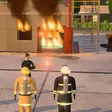
The crew moves from the engine toward the fire, lays the hose and charges the line. Sensor data from the real hose and turbo nozzle drives the virtual scene for every headset.
The Firefighter Virtual Tactical Training Simulation puts sensor-fitted real equipment, Meta Quest 3 and mixed reality on one training ground — saving water and reducing air pollution.
KITEM – Konya Fire Department Virtual Tactical Center, built on Twinup’s Firefighter Virtual Tactical Training Simulation, won Bronze in the Tech-InnovaCity category: a zero-emission, mixed-reality alternative to live-fire training, where crews work fire, hazardous-material and vehicle-rescue scenarios together with real equipment.
The project is a training platform developed for firefighters, volunteer firefighters and related personnel. Its purpose is to save water and to reduce air pollution.
Mixed Reality technology is combined with real firefighting equipment, creating a realistic training and simulation environment: the fire, the smoke and the danger are virtual — the equipment, the crew and every move are real.
Firefighters, volunteer firefighters and related personnel train on the same platform.
Trainees fight a virtual fire with a real nozzle — no real water is sprayed.
No real fire and no real smoke are produced during training.
The real yard and real gear are seen through Meta Quest 3, with virtual fire and smoke on top.
Every move made with the real equipment reaches all participants at the same time, through the central server and Photon.
Various sensors and a Wi-Fi card are added to real firefighting equipment.
Data from the equipment is transferred to a central server over the TCP protocol.
Data reaching the server is distributed to all users through the Photon multiplayer infrastructure.
Participants connect to the server with Meta Quest 3 headsets and experience the scenarios realistically.
The simulation consists of five scenarios. Each can be repeated as often as needed — with real equipment and zero risk.
The crew moves from the engine toward the fire, lays the hose and charges the line. Sensor data from the real hose and turbo nozzle drives the virtual scene for every headset.
The nozzle team cools the hot gases with short pulses, then attacks the seat of the fire. The real nozzle's sensor data drives the virtual stream, and the flames respond.
The team searches a smoke-filled room, finds the casualty and carries them to safety. The casualty is secured with real fixation equipment.
A burning flammable-liquid spill from a leaking tank is tackled with two different types of foam lance. The fire goes out as the foam blanket closes over the surface.
Vehicles are stabilised, the door is opened and the driver is extricated. Many tools specific to this scenario are used virtually, while the Halligan bar and the fixation equipment are real.
The physical equipment is sensor-fitted; the traffic-accident scenario adds a large virtual equipment set.
A management layer provides permission-based access for three user roles and is monitored on the web panel. Applied scenarios, scores and success rates can be tracked and reported according to each user's authority. The values on the right show an illustrative training day.
A real traction-lever joystick, a virtual cab and live crisis injection — wattmen train emergency braking with zero risk.
Open simulation →Direct-drive steering, a moving seat that pitches and rolls, and a passenger-comfort index built from real G-forces.
Open simulation →Let's plan the scenarios, the equipment set and the web panel around your organisation.